
Table of Contents
- Is an Old Lamp Worth Repairing?
- Why Repairing a Lamp Can Make More Sense Than Replacing It
- When Might Replacing the Lamp Make More Sense?
- Table Lamp Repair: Common Problems
- Floor Lamp Repair: What Can Go Wrong?
- Antique Lamp Repair vs. Lamp Restoration: What Is the Difference?
- Repair vs. Replace: A Simple Decision Checklist
- Why Choose a Local Lamp Repair Specialist?
- Looking for Lamp Repair Near Atlanta?
- What Should You Bring for a Lamp Evaluation?
- FAQs
- Final Thoughts: Do Not Replace a Lamp Before You Know Whether It Can Be Saved
An old lamp does not always need to be replaced just because it stops working, flickers, has a damaged cord, or looks outdated.
In many cases, a professional lamp repair can restore the fixture, preserve its character, and allow you to continue using a lamp you already love.
For homeowners searching for lamp repair near me, the real question is often not simply, Can this lamp be fixed? It is:
Is this lamp worth repairing, or would replacing it make more sense?
The answer depends on the lamp’s condition, age, construction, sentimental value, repair needs, and how difficult it would be to find a suitable replacement.
At The LED Lighting Center in Sandy Springs, Georgia, we help customers evaluate table lamps, floor lamps, antique lamps, vintage lighting, decorative fixtures, and other lamps to determine the most practical next step.
In this guide, we will explain seven common signs that repairing your lamp may be a better choice than replacing it.
Is an Old Lamp Worth Repairing?
An old lamp may be worth repairing if it has sentimental value, quality construction, a unique design, replaceable electrical components, or only needs common repairs such as rewiring, socket replacement, switch replacement, or a new cord.
Professional evaluation is especially worthwhile for antique, vintage, decorative, table, and floor lamps that would be difficult or expensive to replace with something similar.
If you are searching for lamp repair in Atlanta or Sandy Springs, bring the complete lamp to a qualified lighting professional so the fixture can be inspected before you decide whether to repair or replace it.
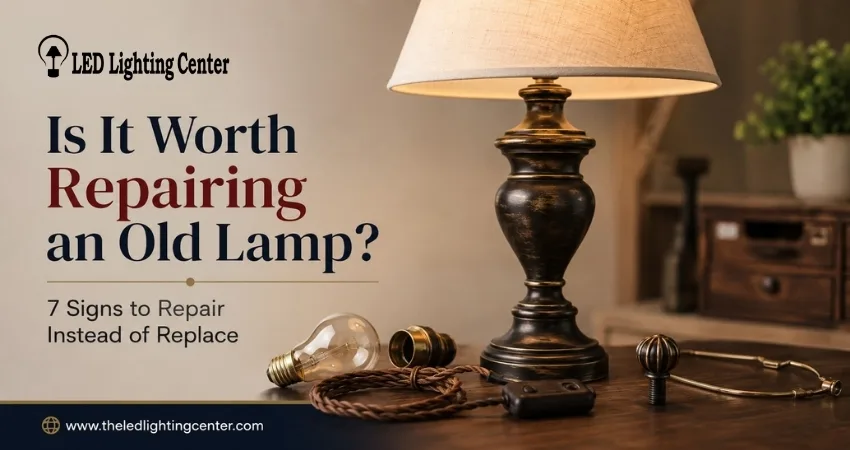
Why Repairing a Lamp Can Make More Sense Than Replacing It
Modern lighting stores and online marketplaces make it easy to buy a new lamp.
But “new” does not automatically mean “better.”
Older lamps may feature:
- Solid metal construction
- Heavy bases
- Hand-finished details
- Unique shapes
- Decorative glass
- Ceramic or porcelain components
- Traditional craftsmanship
- Materials that are difficult to find today
- Personal or family history
A damaged electrical component does not necessarily mean the entire lamp has reached the end of its useful life.
Many problems are limited to components that can potentially be replaced or repaired.
That is why a professional evaluation is often the best first step.
1. The Lamp Has Sentimental or Family Value
One of the strongest reasons to repair an old lamp is simple:
You cannot replace its history.
A lamp may have belonged to:
- A parent
- A grandparent
- Another family member
- A close friend
- A previous generation
- Someone important in your life
It may also remind you of:
- A childhood home
- A family tradition
- A memorable trip
- A special event
- A particular period in your life
Even if an inexpensive replacement lamp could provide the same amount of light, it cannot replace the meaning associated with the original piece.
In these situations, lamp repair is not simply about restoring function.
It is about preserving something meaningful.
Common repairs for sentimental lamps may include:
- Rewiring
- Socket replacement
- Cord replacement
- Switch repair
- Hardware replacement
- Harp replacement
- Finial replacement
- Lampshade replacement
- Cleaning and restoration
If the lamp is structurally suitable for repair, replacing worn components can allow you to continue enjoying it without losing the piece itself.
2. The Lamp Is Antique, Vintage, or Difficult to Replace
Older lamps often have a look that newer fixtures cannot easily reproduce.
Antique and vintage lighting may feature:
- Unusual proportions
- Decorative metalwork
- Traditional finishes
- Unique bases
- Hand-painted details
- Older glass styles
- Ornamental hardware
- Period-specific design
If you own an older lamp that fits your home perfectly, replacing it may be much harder than repairing it.
Even if you find something similar online, the scale, finish, construction, or character may not be the same.
That makes professional lamp repair in Atlanta particularly valuable for customers who own distinctive or older lighting.
Repair can preserve the original character
The goal of repairing an antique or vintage lamp should not be to make it look like a completely different modern fixture.
A thoughtful repair should focus on restoring function while preserving as much of the lamp’s character as reasonably possible.
This may involve replacing internal or electrical components while keeping important visible features intact.
3. The Lamp Has a Damaged Cord, Socket, or Switch
Many lamps stop working because of one relatively small component.
Common examples include:
- Frayed cords
- Brittle wiring
- Damaged plugs
- Worn sockets
- Loose switches
- Broken switches
- Internal connection problems
- Missing hardware
These problems can make the entire lamp appear unusable even when the main body of the fixture is still in good condition.
For example, a beautiful table lamp might stop working simply because the socket or cord needs attention.
That is very different from a lamp whose entire structure is badly damaged.
When to seek professional evaluation
If a lamp shows signs such as:
- Flickering
- Intermittent operation
- A loose socket
- A damaged cord
- A switch that no longer works properly
- Visible wiring damage
- A plug that becomes unusually warm
- An unusual smell
stop using the lamp until it has been properly evaluated.
Electrical components should not be handled casually, especially in antique or unfamiliar fixtures.
A professional table lamp repair or floor lamp repair can help identify the actual source of the problem.
4. The Lamp Still Fits Your Home Better Than Anything New
Sometimes you already own the right lamp.
The height works.
The proportions work.
The finish works.
The lamp fits perfectly beside your sofa, on your nightstand, in your entryway, or next to your favorite chair.
Replacing it may force you to start the entire design process again.
Instead, repairing the lamp can preserve what already works.
You can also update its appearance without replacing the base.
For example:
- Add a new lampshade
- Replace the finial
- Change the harp
- Refresh worn hardware
- Upgrade compatible electrical components
- Adjust decorative details
A well-chosen replacement lampshade alone can make an older lamp feel dramatically different.
This is one reason lamp repair, restoration, and lampshade fitting work so well together.
5. The Lamp Has Quality Construction
Not all lamps are built the same way.
Some older lamps are surprisingly durable.
They may have:
- Heavy metal bases
- Solid structural components
- Quality decorative materials
- Substantial hardware
- Strong internal construction
If the lamp itself is well made and the damage is limited to replaceable parts, repairing it can be a practical choice.
Compare that with replacing it with a lightweight fixture that may not offer the same durability or appearance.
What should be evaluated?
A lighting professional may consider:
- Overall structural condition
- Stability
- Socket condition
- Wiring
- Cord
- Switch
- Base
- Lamp body
- Harp
- Finial
- Shade compatibility
The best decision depends on the entire fixture, not just whether the bulb turns on.
6. The Lamp Only Needs a New Shade or Accessories
Sometimes customers think they need a new lamp when the real problem is the lampshade.
A shade can become:
- Yellowed
- Torn
- Stained
- Bent
- Outdated
- Too small
- Too large
- Poorly matched to the base
Replacing the shade can completely change the lamp.
Choosing the right replacement lampshade
The correct lampshade should consider:
- Width
- Height
- Shape
- Proportion
- Material
- Color
- Fitter type
- Harp size
- Finial
- Intended light output
For this reason, we often recommend bringing the actual lamp when shopping for a replacement shade.
Seeing the shade directly on the lamp makes it much easier to judge whether the proportions and style are right.
A simple refresh may include:
- New lampshade
- New harp
- Decorative finial
- Replacement socket
- New cord
- New switch
Instead of replacing the entire fixture, a few carefully selected components may give it a completely refreshed appearance.
7. You Want to Preserve the Lamp but Update How It Works
An older lamp does not necessarily need to stay exactly as it was originally built.
In some cases, it may be possible to preserve the appearance while updating compatible components.
Customers often want to:
- Rewire older lamps
- Replace worn sockets
- Replace damaged cords
- Update switches
- Use appropriate modern bulbs
- Refresh the shade
- Replace missing hardware
This approach allows the lamp to retain its visual character while addressing worn or outdated components.
For many customers searching for lamp repair near me, this is the ideal compromise:
keep the lamp you love, but restore the parts that need attention.
When Might Replacing the Lamp Make More Sense?
Repair is not always the correct answer.
There are situations where replacement may be more practical.
Examples can include:
Extensive structural damage
If major parts of the lamp are cracked, unstable, broken, or missing, repair may become difficult.
Severe deterioration
Certain materials may deteriorate beyond practical restoration.
Replacement components are unavailable
Some unusual fixtures require specialized components that may no longer be obtainable.
Repair would significantly exceed the lamp’s practical value
For a common inexpensive lamp with no personal significance, replacement may sometimes be more economical.
The lamp no longer fits your needs
Perhaps the fixture is too small, too large, too dim, or no longer works with your space.
In those situations, choosing new lighting may be a better long-term solution.
The important point is that you do not have to make the decision based on guesswork.
A professional evaluation can help clarify your options.
Table Lamp Repair: Common Problems
Table lamps are among the most common fixtures brought in for repair because they are frequently moved, switched on and off, and handled.
Common table lamp repair needs may include:
- Damaged sockets
- Worn switches
- Frayed cords
- Loose connections
- Broken harps
- Missing finials
- Shade-fitting problems
- General rewiring
- Replacement hardware
Because table lamps are often decorative, customers may also want to preserve the original base while updating worn components.
If the base is in good condition, repairing the electrical components may allow the lamp to remain part of the room for many more years.
Floor Lamp Repair: What Can Go Wrong?
Floor lamps face a somewhat different set of problems.
Their height and construction can make them more susceptible to:
- Loose sections
- Damaged sockets
- Switch problems
- Cord wear
- Stability issues
- Missing hardware
- Shade or harp problems
Professional floor lamp repair begins by examining the full fixture.
Because floor lamps may contain wiring running through several sections of the lamp body, diagnosing the problem properly is important.
If you bring a floor lamp in for evaluation, bring as much of the complete fixture as practical, along with any loose or damaged components.
Antique Lamp Repair vs. Lamp Restoration: What Is the Difference?
The terms repair and restoration are often used together, but they can describe different goals.
Lamp Repair
Repair generally focuses on restoring function.
Examples include:
- Replacing a damaged socket
- Rewiring the lamp
- Replacing a cord
- Fixing a switch
- Replacing missing hardware
Lamp Restoration
Restoration may involve broader attention to the fixture.
It can include:
- Repairing function
- Cleaning
- Replacing appropriate components
- Preserving decorative details
- Improving overall condition
- Matching compatible hardware or accessories
The right approach depends on the lamp and what the owner wants to preserve.
For antique or sentimental pieces, the evaluation should consider both function and appearance.
Is Lamp Repair Expensive?
There is no single price for lamp repair because lamps and repair needs vary widely.
Cost may depend on factors such as:
- Type of lamp
- Age
- Wiring condition
- Required parts
- Number of sockets
- Structural complexity
- Accessibility of components
- Restoration requirements
- Replacement hardware
- Additional lampshade or accessory needs
A straightforward socket replacement is very different from restoring an older multi-component fixture.
That is why an evaluation is more useful than assuming a repair price based only on the lamp’s appearance.
A better question to ask
Instead of asking only:
How much will this cost?
also consider:
What would it cost to replace this lamp with something I actually like as much?
For a sentimental, antique, distinctive, or high-quality lamp, those can be very different calculations.
Repair vs. Replace: A Simple Decision Checklist
Ask yourself these seven questions:
- Does this lamp have sentimental value?
- Is it antique, vintage, or difficult to replace?
- Is the problem limited to wiring, the socket, cord, switch, or hardware?
- Does the lamp still work aesthetically in my home?
- Does it appear to have quality construction?
- Would a new lampshade or accessory solve most of the problem?
- Would I prefer to preserve the lamp while updating its function?
If you answered yes to several of these questions, professional repair is worth considering.
Why Choose a Local Lamp Repair Specialist?
Searching online for lamp repair near me is often the first step because many lamp problems are easier to evaluate in person.
A local specialist can physically examine:
- Wiring
- Sockets
- Switches
- Hardware
- Base stability
- Harp compatibility
- Lampshade fit
- Overall construction
You can also explain the history of the lamp and what you want to preserve.
That is difficult to accomplish through photographs alone.
Local service also helps with lampshades and accessories
If the lamp needs more than electrical repair, visiting a lighting showroom can make it easier to explore:
- Replacement shades
- Harps
- Finials
- Bulbs
- Decorative components
- Other compatible parts
Instead of treating each part of the lamp separately, the entire fixture can be considered together.
Looking for Lamp Repair Near Atlanta?
The LED Lighting Center is located in Sandy Springs, Georgia, and serves customers from Sandy Springs, Atlanta, and surrounding Metro Atlanta communities.
Customers visit us for:
- Lamp repair
- Lamp restoration
- Table lamp repair
- Floor lamp repair
- Antique lamp evaluation
- Rewiring
- Socket replacement
- Cord replacement
- Lampshade replacement
- Lamp finials
- Lighting accessories
- Custom lighting
- Lamp transformations
If you are searching for lamp repair Atlanta or lamp repair near me, you are welcome to bring your lamp to our showroom for an evaluation.
What Should You Bring for a Lamp Evaluation?
Whenever possible, bring the complete lamp.
Also bring:
- Any loose parts
- Broken hardware
- Existing lampshade
- Harp
- Finial
- Original components you still have
If the lamp is difficult to transport, contact the store first to discuss the situation.
It is also helpful to explain:
- What stopped working
- How long the problem has existed
- Whether the lamp flickers
- Whether any previous repairs were performed
- What parts you want to preserve
- Whether you want to update the shade or appearance
The more information available, the easier it is to understand the project.
FAQs
Yes, many old lamps are worth repairing, particularly if they have sentimental value, quality construction, a unique design, or require only common repairs such as rewiring, socket replacement, cord replacement, or switch repair.
Many antique lamps can potentially be rewired, depending on their construction and condition. A professional should inspect the fixture before determining the appropriate repair.
Possible warning signs include brittle or damaged cords, inconsistent operation, flickering, worn electrical components, or visibly deteriorated wiring. Stop using a lamp that appears electrically unsafe and have it evaluated.
Many table lamps can be repaired. Common repairs include sockets, switches, cords, wiring, harps, finials, and other compatible components.
Many floor lamps can be evaluated for repairs involving wiring, sockets, switches, cords, structural components, and shade hardware.
Repair may be preferable if the lamp has sentimental, decorative, historical, or replacement value. The decision should consider the lamp’s condition and the extent of work required.
The LED Lighting Center provides lamp repair and restoration services from its Sandy Springs, Georgia location for customers from Sandy Springs, Atlanta, and surrounding areas.
Final Thoughts: Do Not Replace a Lamp Before You Know Whether It Can Be Saved
A lamp that no longer works is not necessarily a lamp that should be thrown away.
Sometimes the solution is a new socket.
Sometimes it needs rewiring.
Sometimes a damaged cord or switch is responsible.
And sometimes the lamp itself is perfectly good—it simply needs a better-fitting lampshade or replacement hardware.
This is especially important for antique, vintage, sentimental, and well-made lamps.
Before replacing a piece you enjoy, consider having it evaluated.
At The LED Lighting Center, our goal is to help customers understand their options and determine whether repair, restoration, replacement components, or a lighting update makes the most sense.
Request a Lamp Evaluation
If you are looking for lamp repair near me, lamp repair in Atlanta, table lamp repair, or floor lamp repair, bring your lamp to The LED Lighting Center in Sandy Springs for an evaluation.
The LED Lighting Center
6136 Roswell Road, Sandy Springs, GA 30328